
| Previous | Next |
|---|---|
| eBook – content table | |
| The Bona Iqiniso Context | The qualitative techniques – context |
| The life cycle – concept |
What is the context for a life cycle
Thaste IT (Bona Iqiniso) uses life cycles to organize its activities. Defining a life cycle is as defining a high-level view of the activities of Bona Iqiniso.
A life cycle represents the useful life of a product or system. Bona Iqiniso sees a life cycle as the high-level implementation of the Bona Iqiniso methodology and reflects all phases from inception to decommissioning.
Typically defined life cycles in software development and IT in general, are:
- Software development life cycle (SDLC)
- Project life cycle (ProjLC)
- Continuous improvement life cycle (CILC)
- Product life cycle (ProdLC)
The life cycle we are interested in for the Bona Iqiniso methodology is the product life cycle.
The reference model
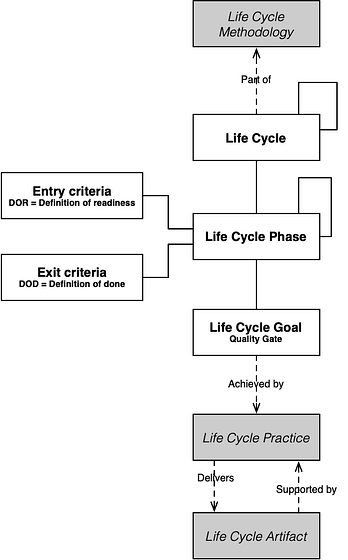
- A life cycle is part of a methodology
- A life cycle is the useful life of a product or system. In our case of Bona Iqiniso.
- There are multiple possible life cycles, but we are only interested in the one that supports Bona Iqiniso.
- A life cycle has one or more phases. A life cycle phase is a distinguishable part of a life cycle occurring over time.
- A phase has a distinct beginning (entry criteria or definition of readiness) and ending (exit criteria or definition of done. Phases within a life cycle may overlap or happen in a different order (depending on the criteria) but are defined as if they occur in sequence.
- Entry criteria or the definition of readiness for a life cycle phase indicates the conditions that need to be reached to start the phase.
- Exit criteria or the definition of done for a life cycle phase indicates when it is possible to close the phase.
- The life cycle goals are linked to the phases and can be considered as the quality gate of the phase. Goals are described in a SMARTER way:
- S – Specific, significant, simple
- M – Measurable, motivational, manageable, meaningful
- A – Attainable, appropriate, agreed, acceptable, agreed
- R – Relevant, result-oriented, result-based, resourced, realistic, reasonable
- T – Time limited, time-framed, able to be timed, trackable, tangible, time-sensitive
- E – Evaluated, ethical, enjoyable, engaging, evidenced
- R – Reviewed, rewarded, recordable
- Life cycle goals are achieved by life cycle practices. These are the methods of the methodology expressed as processes, involving certain stakeholders and using/delivering work products also called deliverables or life cycle artifacts.
This is the theory behind the life cycle reference model. For Bona Iqiniso we will implement a life cycle that feels more natural.
The Bona Iqiniso Life Cycle

This is the Bona Iqiniso Life Cycle in a pragmatic approach and this is the model we will be using throughout Bona Iqiniso. For more detail on the Bona Iqiniso life cycle, see The life cycle – concept
Recent Comments