

| Previous | Next |
|---|---|
| eBook – content table | |
| The qualitative techniques – context | The methods – context |
| The quantitative techniques – concept |
What is the context for quantitative techniques in a methodology
Introduction
Quantitative techniques are instrumental in shaping the data-driven decision-making process, which is critical in today’s data-centred business landscape. These analytical methods encompass the use of metrics, KPI’s, CPI’s, etc. They enable a systematic and scientific way to interpret data, hence providing reliable and accurate results that help build business insights and growth. From predicting quality trends to optimizing resource allocation and improving operational efficiency, quantitative techniques serve as a cornerstone for smart and strategic business decisions. Learning and mastering these techniques can significantly enhance your way of working.
Quantitative techniques are an effective way, as they allow investigation into complex phenomena via numerical data collection and statistical analysis.
Using a quantitative framework presents numerous benefits, particularly in areas requiring data analysis and decision-making processes. One of the significant advantages it offers is its emphasis on objectivity. By using numerical data, it ensures that personal bias is minimized and results are based on factual, measurable evidence. The quantitative framework also lends itself to statistical analysis, allowing for the formulation of trends and patterns that would not be normally obvious. Furthermore, it enables the generalization of results. If the sample size is large and representative enough, the findings from the quantitative framework can be extrapolated to a broader population or situation. Finally, this approach is replicable which boosts its reliability as studies can be reproduced to validate results. Therefore, a quantitative framework’s application can significantly enhance the credibility and dependability of research findings or business decisions, proving its real-world value.
Bona Iqiniso using the following anagram to indicate the use of measurements:
- Measure
- Everything
- That
- Results
- In
- Customer
- Satisfaction
Measurement reference model
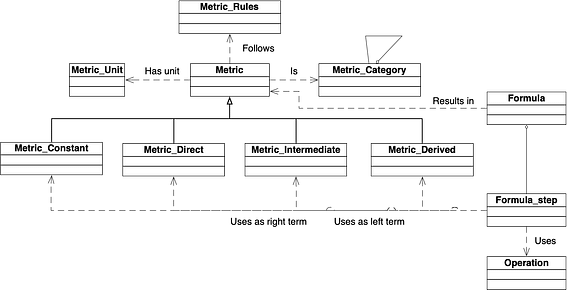
- Metric rules: Rule set to differentiate (Quality)metrics and indicators. If a metric complies to ALL rules, it automatically is a Quality metric, representing a Quality characteristic. Bona iqiniso combines Indicators and Quality metrics in one reference model. Bona Iqiniso makes a difference between indicators and metrics based on 6 rules. If a measurement complies to all 6 rules, it is considered a (Quality) metric, else it is considered an indicator. Only (Quality) metrics relate to “Quality”, where both metrics and indicators can relate to performance/cost/risk/… Indicators (KPI, KCI, KRI, …). The six rules are (Q=Quality, M= Metric):
- Correlation: linear relation Q/M
- Consistency: Improving M = improving Q
- Tracking: Changing M = Changing Q
- Predictability: If M then Q
- Discriminative power: High M,Q ? Low M,Q
- Reliability: M valid for x% of use of M
- Metric: A quantitative measure of the degree to which a system, component, or process possesses a given attribute (IEEE Standard Glossary of Software Engineering Terms). For Bona Iqiniso, this translates into “the definition of the formula or quantitative measure …”. This means that Bona Iqiniso sees a metric as: A constant value (e, pi, 0.01, ….), A complex formula (e.g. “function(f,x)=a*e^(-1/b)”, A simple formula (e.g. “a*b”), A measurable value
- Metric unit: Every metric is expressed in a metric unit (%, number, ratio, etc.)
- Metric category: A metric is a quantitative measure that may represent Quality characteristics and/or indicators.
- Metric constant: A metric that has a constant value. In the true sense of the definition, this is not a metric, but for simplicity reasons, Bona Iqiniso considers constant values as a metric, because Bona Iqiniso will use metrics also to define criteria, which most of the time are constant values.
- Metric direct: A metric that can be measured directly or that is directly available in a system other than Bona Iqiniso.
- Metric intermediate: A metric that is defined by a simple formula. A simple formula has 1 or 2 terms and 1 operation. E.g. I1 = -1 / 7; I2 = e^I1; function(f,x)= a*I2.
- Metric derived: A metric that is defined by a complex formula. A complex formula has 3 or more terms, 2 or more operations and brackets to indicate the order of operations. E.g. function(f,x)=a*e^(-1/b) which has 4 terms (a, e, -1, b) and 3 operations (*,^, /)
- Formula: A formula is an ordered sequence of formula steps. Calculation of the formula is done following the formula steps in increasing order.
- Formula step: A formula step is the definition of an operation with 1 or 2 term and 1 operation. E.g. Left term + Right Term; Blank Log Right term; etc.
- Operation: An operation is the kind of calculation to be executed on 1 or 2 terms.
Conclusion
Incorporating a measurement framework in the Bona Iqiniso methodology can provide structure and objectivity to the use of quantitative techniques. By defining clear metrics and indicators, it is easier to track progress and evaluate the effectiveness of the methodology. However, we made sure that the framework is flexible enough to accommodate different types of data and analysis techniques, and that the metrics used are truly meaningful and relevant to the goals of Bona Iqiniso. Overall, a measurement framework can be a valuable tool in optimizing the use of quantitative techniques in a methodology.
Recent Comments