

Introduction to Bona Iqiniso
Context
Context definition:
– The circumstances that form the setting for an event, statement, or idea, and in terms of which it can be fully understood.
– The process to determine and describe (high level) the work at hand. The scope, the boundaries, dependencies, etc.
A testing professional’s first and only question would be “Why do we need a new software testing methodology?”
Good question. Good Remark. I hope you give me a chance in this chapter to convince you why we need a new methodology. In fact, there are two reasons for it.
To explain the first reason we have to look at human nature and behavior. In psychology, there is something called ‘cognitive behavioral therapy’ (CBT) that helps people to understand why they behave in a certain way and helps them to change this behavior if necessary.
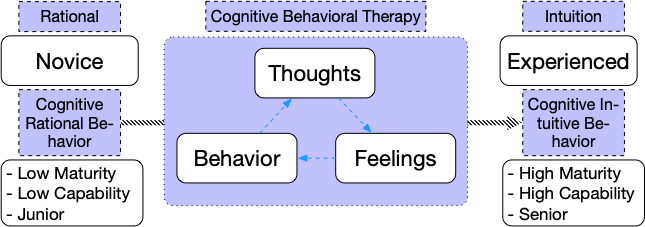
Figure 1: Cognitive Behavior Therapy
CBT is based on “how you think leads to how you feel and will ultimately determine your behavior”. E.g. if you think you failed, you will feel depressed and your behavior will show demotivation and uncertainty which again leads to more failures. This explains how people can get into a downward spiral leading to depression.
On the other hand, it also can explain positive behavior. You think you are smart and well-liked, feeling supported and optimistic leading to assertive behavior.
More generally, it explains why people act in a certain way and how their capability and maturity in a certain field influence this behavior.

Figure 2: Cognitive Intuitive or Rational Behavior
If you are a novice, you will feel insecure, and you will tend to rationalize what you are doing and build your experience on a proven foundation (teachers, mentors, books, etc.) because that makes you think “I am doing things right”. This is “Cognitive Rational Behavior”.
After a while, you gain experience and become more intuitive in what you are doing, you will feel more secure, and your behavior is more intuitive and based on previous experiences. Success in what you do will lead to making you think “I am doing things right”. This is “Cognitive Intuitive Behavior”.
This “learning curve” also explains why human nature leads to multiple methodologies for software testing.
In CBT there is a treatment method called ABCDE that can explain the existence of multiple methodologies:
- A. Activating Experience
- B. Beliefs (Irrational feeling)
- C. Consequence (Extreme thinking)
- D. Dispute
- E. Effect (Moderate/balanced thinking)

Figure 3: A B C D E method in Cognitive Behavior Therapy
We all started as novices in software testing. We learned to do software testing and followed one or another methodology. We executed the methods within that methodology, forced to learn other methodologies, but with time we formed our own belief system and started favoring certain methodologies, certain methods. As human nature, it is normal that we looked at what we did in extremes. This is the best, this is the worst and if at that point in time, you used multiple methodologies, you will favor one methodology above another, but perhaps favor methods from multiple methodologies.
A testing professional will dispute these feelings and search for reasons why he thinks one method is better than another is. He will build up an argumentation, ask for advice, self-reflect and in the end, he will think more balanced about methodologies and methods.
He went from a rational behavior to a more intuitive behavior. He still will be successful in his testing endeavors, or even be more successful.
No experienced testing professional will blindly execute all methods of one methodology, he will, knowingly, or not, execute his favorite methods in what seems to be a “New” methodology.
Therefore, writing a book to describe a brand-new software testing methodology is natural.
I also promised a second reason why it is normal to have a new software testing methodology and for that, we go to the definition of what a methodology is.
Methodology is the systematic, theoretical analysis of the methods applied to a field of study. It comprises the theoretical analysis of the body of methods and principles associated with a branch of knowledge. Typically, it encompasses concepts such as paradigm, theoretical model, phases and quantitative or qualitative techniques.
If you wonder what paradigm means (I also had to look it up), it means
a distinct set of concepts or thought patterns, including theories, research methods, postulates, examples and standards for what constitutes legitimate contributions to a field of expertise
This is also the right moment to mention that this book is not alone about theories. It also tries to bridge the gap between conceptual thinking and solution driven thinking. Therefore, this book contains a number of meta-models to explain main components and relationships between these components.
Below you can see the meta-model if we follow the above definition of the word “methodology”.

Figure 4: Meta model “Methodology”
Whether you follow this definition, or another, does not really matter at this point. Experience teaches us that to implement a methodology people will use multiple tools, because there is not such a thing as one tool fits all, leading to the need to align all tools used which will lead on its turn to overhead. Overhead that is annoying when you are in the middle of a software-testing project. Another consequence is also that most tools are open, allowing multiple workflows, or focus on one single aspect within a workflow.
Since Thaste IT has a tool, Bona Iqiniso, a test automation tool made by test analysts for test analysts, we tried to figure out how to use this tool in the existing methodologies and the consensus was that in the end we would be one of the tools in an ocean of tools.
We, at Thaste IT, are realistic enough to know that we will not be the ones to build the “one tool fits all”. However, we do believe that we can reduce the number of tools needed and more importantly make a “closed” tool, a tool that has one workflow to guide novice software testers and one workflow that trusts the expertise and intuition of the experienced software professional.
The only way to create a “closed” tool is to make it cover a methodology that only consist of methods, practices, quantitative and qualitative techniques and phases.
Concept
A concept is:
– An abstract idea representing the fundamental characteristics of what it represents. Concepts arise as abstractions or generalisations from experience or the result of a transformation of existing ideas.
– The process of planning the work at hand, including stakeholders, deliverables, resources, etc.

Figure 5: Concept of the Bona Iqiniso Methodology
The concept of the Bona Iqiniso Methodology is simple enough. Cover all parts in the Methodology meta-model and make sure that everything which is described is also part of the Bona Iqiniso Tool, or is at least planned to be part of the Bona Iqiniso Tool.
Implementation
Implementation is:
– The realization of an application, or execution of a plan, idea, model, design, specification, standard, algorithm, or policy.
– The process of executing a plan.
The chapters that follow show the implementation of the Bona Iqiniso Methodology and its implementation in the Bona Iqiniso Tool. The implementation of the methodologies is described using a number of generic reference models.
The next chapter will describe these generic reference models. It is not only the intention to use these reference models to describe the Bona Iqiniso Methodology, but also the interaction between all the components of the methodology, the relationships.
Verification
Verification is:
– “proving the truth” or “confirmation”. Verification is an auditing process in which an auditor satisfies himself with the actual existence of assets and compliance of these assets with predefined specifications.
– The process of confirmation that the work at hand has been implemented establishing its truth, accuracy, or validity.
The appendices show how to verify the correct execution of the Bona Iqiniso Methodology?
Recent Comments