

The concept of Bona Iqiniso
Introduction
A testing board is a fundamental pillar of Bona Iqiniso and of software development in general providing a structured approach to testing software applications.
For the business domain, the application board, and the roadmap we mentioned that we are not touching the process side of these topics and we did that with a good reason. Our reason is that we want to approach these pillars from within the processes we define for the testing board pillar. Being a software testing methodology we want to be as complete as possible for software testing, but we don’t want to make something complex even more complex.
Software testing plays a crucial role in ensuring the quality and reliability of software systems. To achieve effective and efficient testing processes, organizations often rely on industry-recognized standards and frameworks. ISO 29119, an international standard for software testing, provides guidelines and best practices for planning, executing, and managing software testing activities. Let’s explore the rationale behind using a software testing framework based on ISO 29119 and the benefits it offers to organizations.
- Consistency and Standardization: ISO 29119 offers a standardized approach to software testing, enabling organizations to establish consistent testing processes across projects, teams, and departments. By adhering to this framework, companies can ensure that testing activities are performed in a consistent manner, reducing variability and improving the overall quality of the software being developed. Consistency in testing practices also facilitates collaboration, knowledge sharing, and smoother transitions between team members.
- Improved Test Planning and Documentation: ISO 29119 emphasizes the importance of thorough test planning and documentation. The standard provides detailed guidance on creating test plans, test designs, and test cases, ensuring that testing activities are well-documented and aligned with project objectives. With a standardized approach, organizations can systematically identify and address risks, dependencies, and potential issues in the software being tested. Comprehensive documentation also aids in traceability, making it easier to track the progress of testing activities and assess their effectiveness.
- Enhanced Test Coverage and Risk Mitigation: ISO 29119 promotes a holistic approach to testing by emphasizing the need for comprehensive test coverage. The framework encourages organizations to identify and test various dimensions of quality, including functional, non-functional, and structural aspects. By following this approach, software testers can verify that the system meets the intended requirements and functions as expected under different scenarios. Additionally, ISO 29119 emphasizes risk-based testing, enabling organizations to prioritize test activities based on the potential impact and likelihood of risks, thus optimizing testing efforts.
- Increased Stakeholder Confidence: Implementing a software testing framework based on ISO 29119 demonstrates a commitment to quality and best practices. It provides assurance to stakeholders, including clients, customers, and regulatory bodies, that the software has undergone a rigorous testing process. This, in turn, enhances stakeholder confidence and strengthens the organization’s reputation for delivering reliable and high-quality software products.
- Compliance with Industry Standards: In certain industries, adherence to recognized standards is mandatory. ISO 29119 aligns with other software engineering and quality standards, such as ISO/IEC 12207 and ISO/IEC 9001. By adopting a testing framework based on ISO 29119, organizations can demonstrate compliance with these industry standards, making it easier to meet regulatory requirements and participate in projects where adherence to specific standards is a prerequisite.
Iso 29119 Framework (detailed)
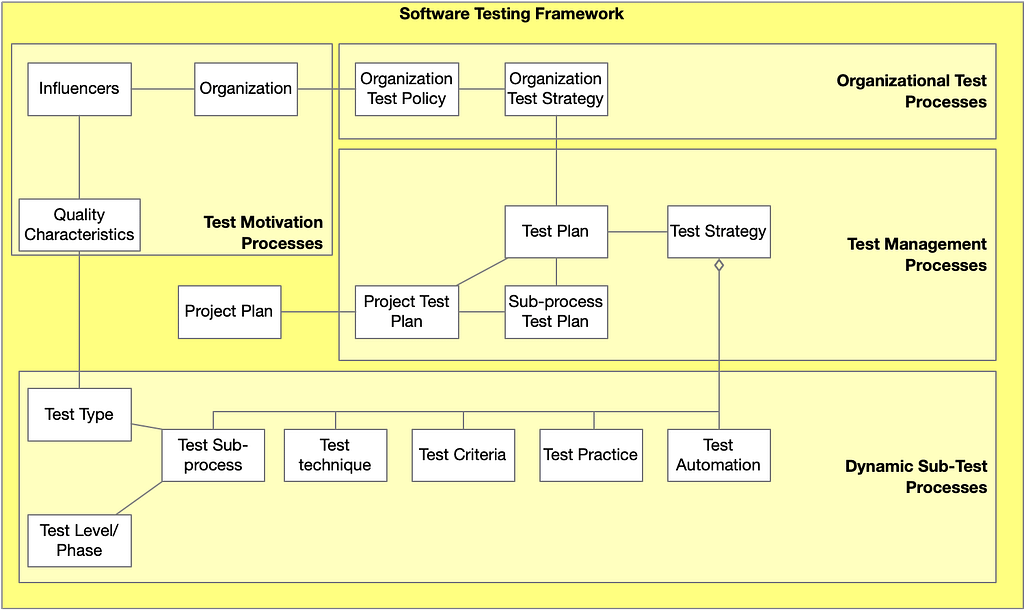
Framework principles
- Software testing is not a goal. It is a means to establish the ‘quality’ of a product. Hence the link between the business motivation model and the software testing (framework) model.
- Software testing is part of something bigger which are the four pillars: business domain, application board, roadmap, and testing board. These are the ingredients for successful software development projects.
- A way to logically group all software testing topics and organize them in the organization is to approach software testing as a methodology.
- Describing software testing as a methodology helps to avoid gaps, and inconsistencies.
- Software testing is a means to an end and therefore there must be a motivation to do it.
- Motivation comes from influencers both internal and external to the organization.
- Influences can be quality-driven, requirements, or remediations to something that is not optimal or can be part of a continuous improvement effort.
- Any influence relates to a test sub-process linked to a test type, or not.
- Software testing covers organizational test processes, test management processes, and (static & ) dynamic test processes.
- The detailed framework must be seen as a checklist combined with what makes a methodology and project management (four pillars).
- Additional frameworks/models are required to detail the software testing framework.
Bona Iqiniso Concept
To explain the Bona iqiniso Concept, the way we will describe software testing in Bona Iqiniso, we’ll first give a schematic overview of its context. That will make things clearer and help us organize and structure every aspect of the concept of Bona Iqiniso.

As you can see, we focus in Bona Iqiniso on one specific qualitative technique: the software testing framework. This framework contains a set of methods that we need in our day-to-day operations to make sure we ‘do’ software testing the best way possible.
Bona Iqiniso, being a methodology, is described by these methods. Each method will cover the other aspects of a methodology: the life cycle relevant to the method, qualitative/quantitative techniques (frameworks and/or reference models) to describe all aspects of how the method fits in the organization, who is involved, what to do, what products to use and produce, how to gradually introduce the method in the organization, how to assess the method is correctly applied and objectively measure this, what quality needs it covers and how it fits in the quality management (system) framework of the organization, and the method also contains its paradigm: referenced material, templates, guidelines, checklists, examples, tooling, etc.

If we would link all methods to a “software testing framework”, we would create a flat structure, meaning that we end up with a library with a huge amount of method descriptions, without structure, without organization. For that reason, Bona iqiniso ‘layers’ the software testing framework. This layering comes from ISO 29119.
Therefore, if we zoom in on the software testing framework, we see:

It is important to notice that a method often will be part of several ‘nodes.’ E.g. a testing process (method) impacts the organizational test processes, the test management processes, and the dynamic test sub-processes.
Conclusion
A software testing framework offers numerous advantages to organizations seeking to improve their testing processes and deliver high-quality software products.
It provides consistency, standardization, and documentation, enabling organizations to plan and execute testing activities effectively.
Furthermore, it enhances test coverage, mitigates risks, and instills stakeholder confidence.
By adopting the ISO 29119 software testing framework, organizations can establish a robust testing framework quite rapidly, using the information available in the ISO 29119 standard, and elevate the overall quality of their software development lifecycle.
Additionally, The ISO 29119 software testing framework provides
Recent Comments