

The Concept of a Stakeholder Framework
The stakeholder framework is a conceptual model used to analyze and understand the various individuals, groups, or organizations that have an interest, influence, or are affected by a particular area of knowledge, project, policy, or decision. It provides a structured approach to identify and prioritize stakeholders based on their level of importance, power, and proximity to the project.
Bona Iqiniso considers:
- Stakeholder influencers can be internal to the organization. E.g. the board of directors wants full transparency and traceability where software testing is concerned.
- Stakeholder influencers can be external to the organization. E.g. The European Digital Operational Resilience Act dictates what is expected of financial institutions regarding software testing, business continuity, disaster recovery, risk management, etc.
- Stakeholders can also be participants influencing the input of a software testing process or the outcome of a software testing process. They even may participate in the software testing process.
The stakeholder framework also considers the level of influence and interest each stakeholder holds. This helps project managers identify key stakeholders who should be actively engaged and communicated with throughout the project lifecycle.
Analyzing stakeholders within the framework allows organizations to assess potential risks, conflicts, and opportunities associated with the project. It helps in developing strategies to manage and address stakeholder concerns, ensure their satisfaction, and ultimately increase the project’s chances of success.
Overall, the stakeholder framework is a valuable tool for organizations to navigate complex projects, policies, or decisions by identifying, prioritizing, and effectively managing the diverse range of individuals and groups involved or impacted by the project.
Many factors can influence the way software testing is done in an organization, and it is essential to understand and address these stakeholders to ensure successful software testing.
Bona Iqiniso sees the stakeholder reference model as a reference base to indicate influences. In that perspective, a more correct name would have been the Influencer reference model, but since stakeholder is a more generally accepted term, the name stakeholder reference model has been chosen. Mentioning this means that the reference model also will include (non-human/organizational) influences which are not that obvious, like regulations, assumptions, company values, etc.
Stakeholder Reference Model
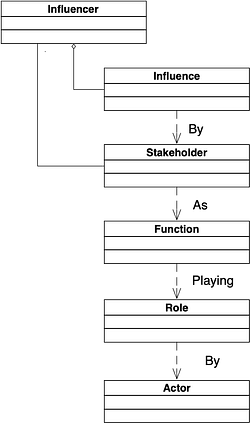
- Influencer: All entities that have an influence on the success of the organizational unit.
- Influence: Categorization of influences. E.g. An assumption, a habit, a regulation, a technology, etc. All will influence what we are doing. Influences are impersonal, meaning they can be shared between multiple stakeholders. Every influence is linked t at least 1 stakeholder.
- Stakeholder: an individual, group, or organization that has a vested interest or concern in the activities, decisions, or outcomes of a particular organization. Stakeholders can include various parties such as employees, managers, customers, suppliers, shareholders, investors, government entities, regulatory bodies, and even the general public. Each stakeholder may have different expectations, needs, and influence over the organization’s operations and success. It is important for organizations to identify and engage with stakeholders to understand their perspectives and incorporate their input in decision-making processes.
- Function: A process or operation that is performed routinely to carry out a part of the mission of an organization. They can be divided into core functions and support functions.
- Role: The usual or expected function of an actor or the part somebody or something plays in a particular action or event. An Actor may have a number of roles. The part an individual plays in an organization and the contribution they make through the application of their skills, knowledge, experience, and abilities.
- Actor: A person, organization, or system that has a role that initiates or interacts with activities; for example, a sales representative who travels to visit customers. Actors may be internal or external to an organization.
Recent Comments