

The Bona Iqiniso Mission & Vision Statement
| Previous | Next |
|---|---|
| eBook | Rationale |
| Introduction |
Introduction
If the origin of Bona Iqiniso is within the science of cognitive behavior, it is not more than natural to use cognitive behavioral techniques in defining Bona Iqiniso. After all, we want Bona Iqiniso to feel natural, common sense rules, while focusing on what is important in software testing and within the lifecycles where Bona Iqiniso is implemented, and this with the purpose to increase the effectiveness and efficiency of testing.
Bona Iqiniso is a methodology and we have seen in the ‘WHY’ section of the methodology guide, that cognitive behavior, in fact, encourages new ways of thinking, and therefore also encourages new methodologies.
The Bona Iqiniso mission statement
Bona Iqiniso feels natural, lets common sense rule, while focusing on what is important in software testing and within the lifecycles where Bona Iqiniso is implemented, and this with the purpose to increase the effectiveness and efficiency of testing.
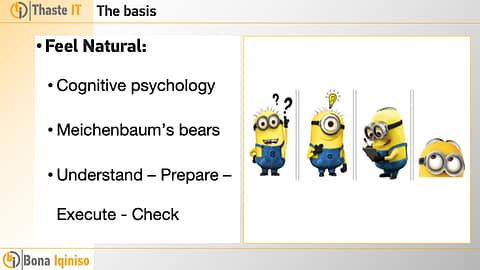
One of the techniques used in cognitive behavioral psychology is the 4 bears of Meichenbaum. It’s a technique based on the natural way humans approach a task.
- Understand what you need to do. Determine the context of the task.
- Plan and prepare what you need to do. Define the concept of the task.
- Execute what you need to do. Go ahead with the implementation of the task.
- Check what you have done. Perform verification of the task.

Most of what is described in Bona Iqiniso will follow these 4 stages: context, concept, implementation, and verification. This is enough to describe everything in a methodology.
But, it is not enough when we approach software testing, nor how we approach quality.

In software testing, within the testing team/department, we still are executing tasks that follow the 4 stages: context, concept, implementation, and verification, but software testing is done for customers. In software testing, these customers must have a final saying, which we call ‘validation’. Therefore software testing goes through 5 stages: context, concept, implementation, verification, and validation.

We also will see that Bona Iqinsio leads to a software testing framework, and this framework is influenced in different ways. What these influences have in common is that they express a certain quality characteristic. Quality in Bona Iqiniso follows the 5P method:
- People: They (customers) are the ‘
why‘ we will do software testing, but they (team) are also the ‘who‘ will do software testing. That’s why people are an important and intrinsic part of Bona Iqiniso. - Process: Software testing is not just one process (method). It is a collection of processes. These processes are the ‘
how‘ we do software testing. Each process is a method in the Bona Iqiniso methodology. - Product: This is the ‘
what‘ will we test. The ‘product under test’, the ‘system under test’. It is the test basis in Bona Iqinsio. - Project: During a project, we define a roadmap to decide ‘
which‘ part of the product is made ‘when‘ in time. - Productivity: We want time-to-market to be as short as possible and therefore software testing needs to be as effective and efficient as possible by making testing the product on a selective number of environments, each next environment being more production-like than the previous environment. This is ‘
where‘ we will do software testing.

Bona Iqiniso Vision Statement
Bona Iqiniso has the goal to combine quality (people, process, product, project, productivity) with the natural stages in software testing (context, concept, implementation, verification, validation), and this based on 4 pilars: Business domain, Application board, Roadmap, and Testing board.
Why only 4 pillars?
Because people are central to all that Bona Iqiniso stands for. Without people, both team and customer there is no Bona Iqiniso. People are embedded in the tasks at hand. A process will have suppliers and customers, a project has a team and customers, A product is built for customers by a team, and productivity can only be guaranteed when people work together. That’s the reason why Bona Iqiniso does not have a separate pillar for people.
How do the other pillars function?
Business domain: In software development, we often generalize our customers by calling them the ‘business’. They define the context of what will be built and tested and they decide on the ‘action flows’ in the product. These action flows are like the processes we follow to do software testing.
Application board: An overview of all functionality in the product, giving us the concept of what the product will contain.
Roadmap: The project plans, designs and builds the product. The project implements the product.
Testing board: effective and efficient verification and validation of the product is the result of the productivity enabled by the synergy of people, processes/context/business domain, project/implementation/roadmap, and product/concept/application board.
This is the foundation of the Bona Iqiniso Methodology.
| Previous | Next |
|---|---|
| eBook | Rationale |
| Introduction |
Recent Comments